

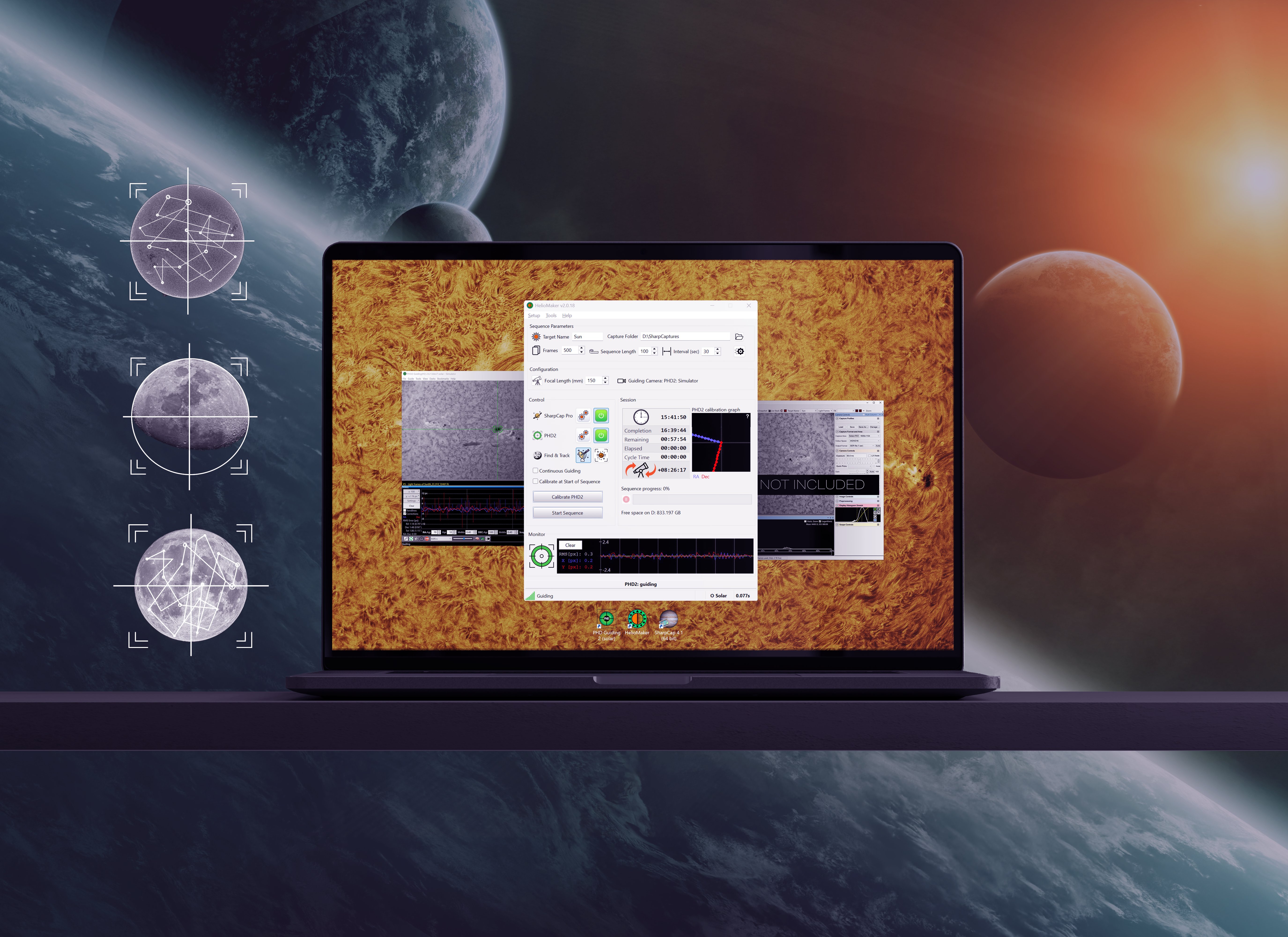

Capture the August 2, 2027 Total Solar Eclipse with HelioMaker 2.0
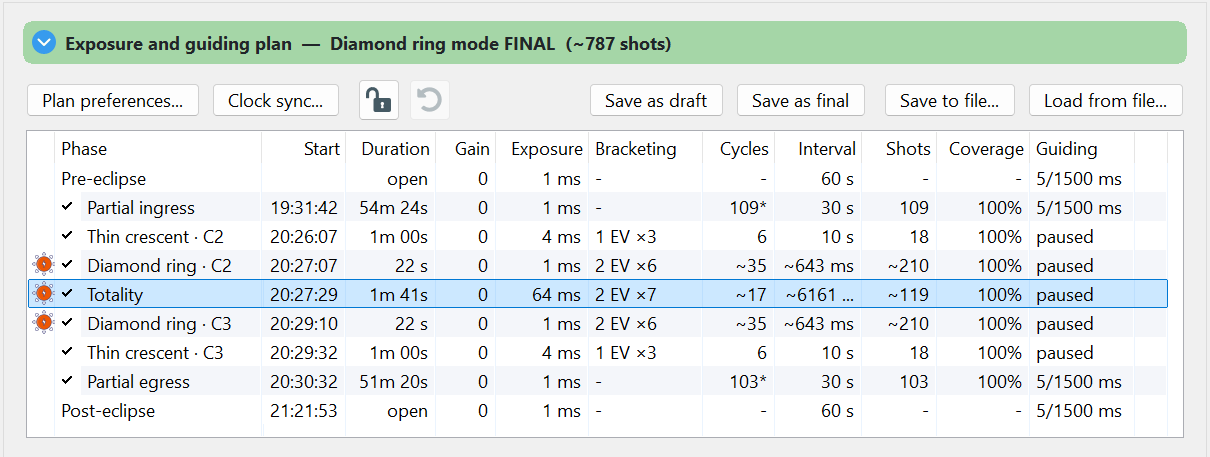
HelioMaker 2.0 calculates your local eclipse circumstances and automatically builds a complete phase-by-phase imaging plan. After rehearsal, it orchestrates SharpCap capture, exposure changes, solar tracking and guiding, timing, and optional refocusing throughout the event, leaving you free to enjoy the eclipse and handle only solar-filter removal and replacement near second and third contact.
Recommended in The Solar Observer’s Handbook
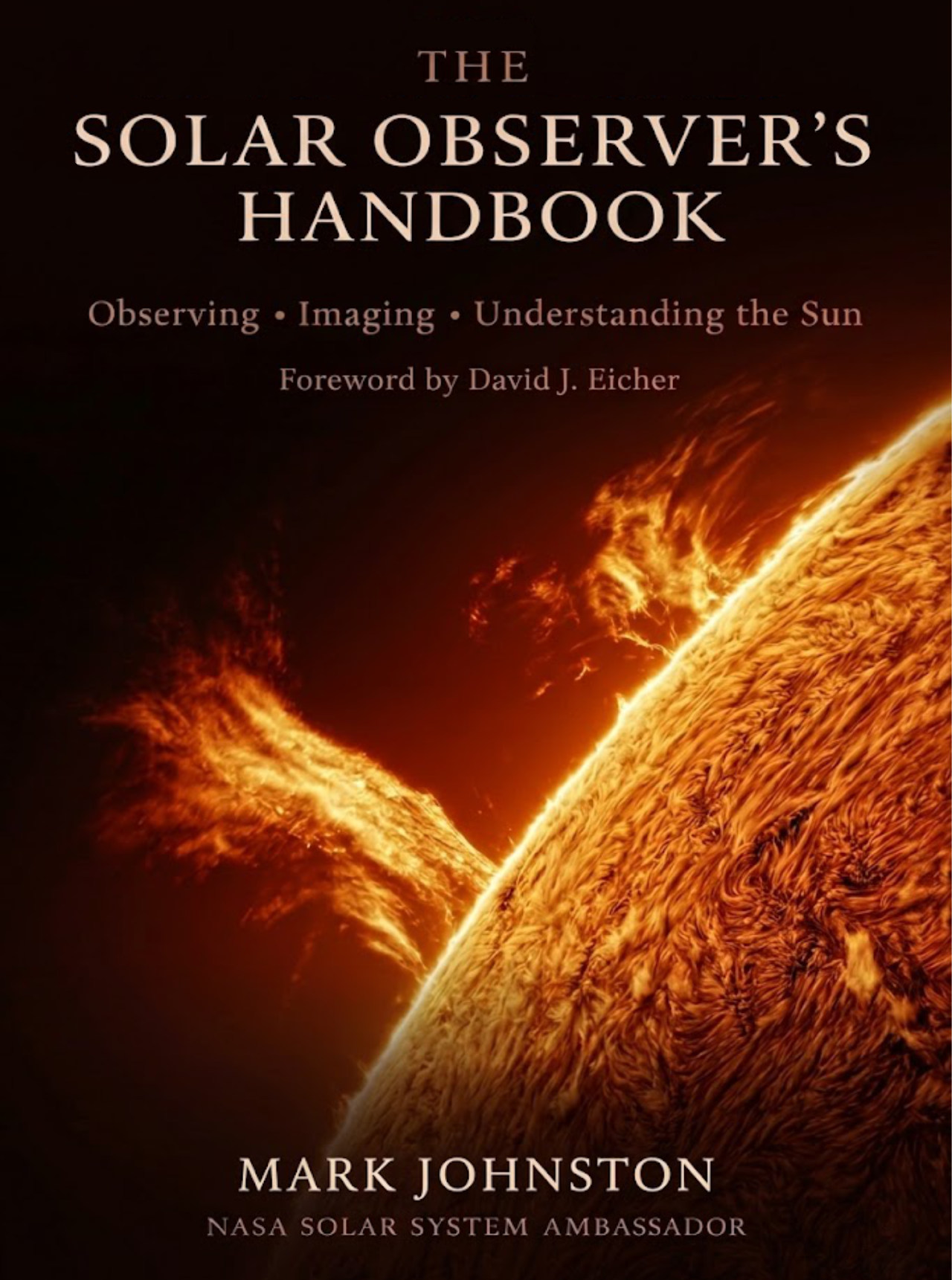
HelioMaker is recommended for solar guiding in Mark Johnston’s The Solar Observer’s Handbook, a practical resource for solar observers and imagers.
In the section on guiding on the Sun, the handbook discusses long-duration solar time-lapse imaging and lists HelioMaker as the recommended guiding option.
Learn more about the handbook:
Bringing Planning, Capture, and Guiding Together
HelioMaker brings SharpCap Pro and the custom solar version of PHD2 into one coordinated workflow for solar-system imaging. SharpCap controls the camera and image capture, PHD2 provides precision guiding, and HelioMaker manages target detection, planning, sequencing, tracking, and recovery.
The same telescope and planetary camera can be shared between imaging and guiding, reducing equipment requirements and eliminating the need for a separate guide scope in many solar, lunar, and planetary workflows. HelioMaker also supports setups with a dedicated guide scope and camera when that arrangement is more suitable.
HelioMaker 2.0 expands this integration with a complete Solar Eclipse Planner and Imaging Tool. It can calculate local eclipse circumstances, build and rehearse a phase-by-phase imaging plan, coordinate SharpCap capture and solar guiding, and manage the live sequence through partial phases, diamond rings, Baily’s beads, and totality.
Beyond eclipse imaging, HelioMaker supports long-duration time-lapse capture, guiding on full disks, crescents and surface details, Dynamic Target Tracking, minor-body workflows, and experimental spectroheliograph scanning.
HelioMaker connects two established astronomical imaging tools without replacing or duplicating their core functionality. SharpCap Pro provides camera control and image or video capture, while the custom solar version of PHD2 provides guiding on the Sun, Moon, planets, and visible surface detail. HelioMaker coordinates these components into a unified imaging workflow.
In many solar, lunar, and planetary setups, the main telescope and planetary camera can be used for both imaging and guiding. This simplifies the equipment configuration, reduces cost, and can remove the need for a separate guide scope and additional solar-filtered guiding camera. Dedicated guide scopes and cameras remain supported when they are better suited to the workflow.
Dynamic Target Tracking Tool
Improves tracking accuracy by continuously updating the mount’s tracking-rate offsets for the selected solar system target. This can substantially reduce drift compared with standard built-in solar, lunar, or planetary tracking rates and also improves related guiding and calibration workflows.
Find & Track Tool
Includes HelioMaker’s advanced Full Disk/Crescent, Planetary, and Surface Features detection modes. Surface-feature detection, originally developed for the custom PHD2 version, now runs directly within HelioMaker, improving performance, consistency, and long-term maintainability.
By detecting and tracking solar or lunar surface detail through the main imaging telescope, HelioMaker can guide at the same image scale used for capture. This provides greater precision than a short-focal-length guide scope in high-magnification workflows and helps maintain stable framing during extended imaging and time-lapse sessions.
Track, Slew To, and Guide on Solar System Bodies
HelioMaker 2.0 extends PHD2’s basic comet-tracking workflow into a complete planning, pointing, tracking, and guiding system for natural Solar System bodies.
Targets can be selected using data from the JPL Horizons system or calculated through HelioMaker’s local CSPICE-based ephemeris engine. HelioMaker can then slew the telescope to the predicted position, apply the required target motion, and coordinate guiding throughout the imaging session. Depending on the target and equipment configuration, HelioMaker can use mount tracking-rate offsets or PHD2 star guiding with calculated shift rates. This supports comets, asteroids, planetary moons, and other natural Solar System objects without requiring the operator to manually calculate or enter their apparent motion.
Artificial satellites are not supported.
Eclipse Planning and Automated Imaging
Plan, Rehearse, and Automate Total Solar Eclipse Imaging Through December 2027
The centerpiece of HelioMaker 2.0 is its new Solar Eclipse Planner and Imaging Tool, a complete workflow for preparing, rehearsing, and running an automated total solar eclipse imaging session. HelioMaker finds eclipses visible from the observer’s location, calculates local contact times and eclipse geometry, and builds a phase-by-phase imaging plan.
Exposure, gain, HDR bracketing, capture intervals, guiding behavior, refocusing, and filter transitions can all be configured in advance for the partial phases, thin crescents, diamond rings, Baily’s beads, and totality.
Dry and wet simulations allow the complete sequence to be rehearsed before the event, while comprehensive pre-flight checks verify the equipment and configuration before the plan is armed. During the eclipse, HelioMaker coordinates SharpCap capture, optional PHD2 solar guiding and refocusing, and provides live progress, equipment status, recovery warnings, and visual and audio filter cues.
The goal is to prepare and test everything beforehand, allowing HelioMaker to manage the imaging sequence while the observer spends less time operating software during totality.
The eclipse workflow also includes dedicated safeguards for system sleep and resume, attempted application shutdown, camera reconnection, temporary target loss, and incomplete capture operations. Live status information and recovery warnings show whether HelioMaker recovered automatically or whether operator intervention is required.
Eclipse camera compatibility: The current automated eclipse workflow is designed for fast planetary cameras controlled natively by SharpCap. DSLR and mirrorless cameras are not currently supported.
Plan and Automate Lunar Eclipse Imaging
HelioMaker 2.0 now adds a complete Lunar Eclipse Planner and Imaging Tool for guided, automated capture of lunar eclipses.
HelioMaker calculates the eclipse circumstances for your observing location, builds the imaging sequence around the different eclipse phases, and coordinates SharpCap capture with PHD2 guiding throughout the event. The planner lets you preview and rehearse the sequence in advance, then follow its progress during the actual eclipse.
Unlike a conventional fixed time-lapse, the imaging plan can adapt capture settings to the changing brightness of the Moon as it moves through the penumbra, umbra, and totality, while HelioMaker keeps the lunar image accurately positioned through the multi-hour event.
Together, the Solar and Lunar Eclipse tools make HelioMaker 2.0 a unified platform for planning, rehearsing, guiding, and automating eclipse imaging.
Automated Sequencer
Beyond eclipse imaging, HelioMaker’s Automated Sequencer remains the workhorse for routine solar, lunar, and planetary imaging and long-duration time-lapse sessions.
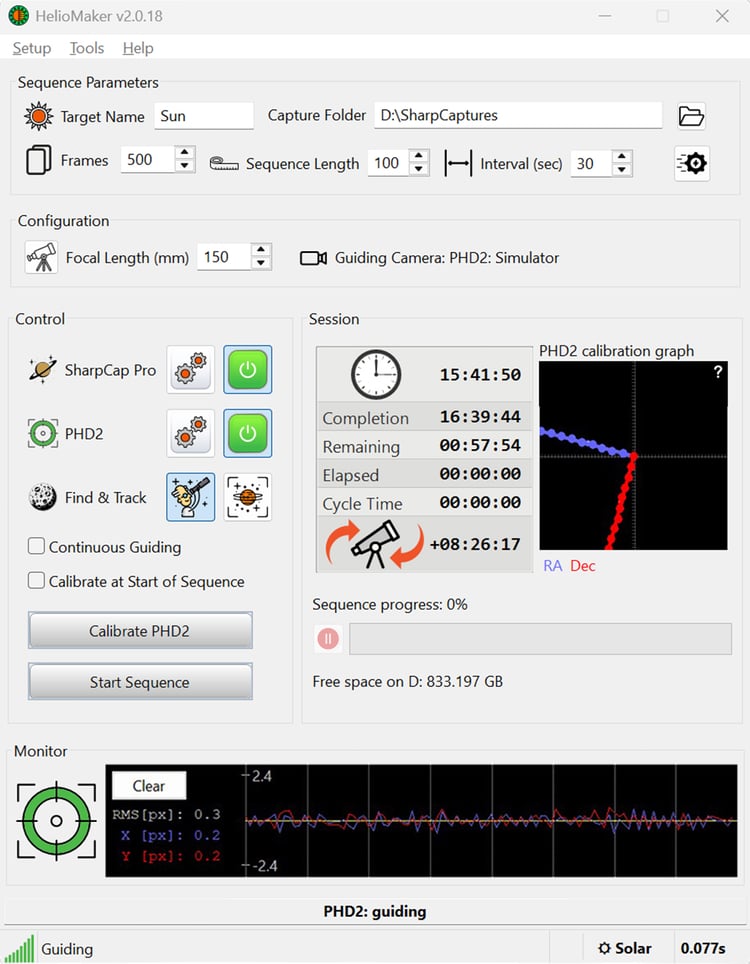
HelioMaker coordinates repeated video or image captures in SharpCap Pro with target detection, calibration, guiding, capture timing, and optional refocusing. It provides centralized control of the imaging workflow while monitoring capture progress, guiding state, and communication with the connected applications.
Alternatively, capture sequences can be managed directly in SharpCap while HelioMaker and the custom solar version of PHD2 handle target detection and guiding. This allows existing SharpCap workflows and scripts to be used without giving up HelioMaker’s tracking and guiding capabilities.
Throughout a session, SharpCap’s histogram, focusing tools, seeing monitor, and other camera controls remain available. PHD2 also remains fully accessible, allowing detection and guiding parameters to be inspected or adjusted before and during capture.
Spectroheliograph Scanner
HelioMaker 2.0 introduces experimental support for mount-driven solar scanning with Sol’Ex-style and similar spectroheliograph systems.
The scanner uses HelioMaker’s internal ephemeris model to determine the Sun’s apparent diameter in real time, avoiding the need to estimate the disk size from the camera image. It supports scans in both right ascension and declination, with configurable single-pass or multipass operation.
Because mount capabilities vary, HelioMaker examines the connected mount and selects the best available scanning method. It can use custom tracking-rate offsets where supported or compatible preset slew speeds when custom rates are unavailable. The available scan directions, speeds, and timing options are adapted to the mount’s actual capabilities and limitations.
SharpCap records the solar video during each scan, while reconstruction is performed afterward using external SHG software. An optional dedicated solar guide scope and camera can be used to guide on the full solar disk and recenter it accurately between passes, improving repeatability during multipass scans and extended imaging sessions.
Advanced Detection and Reliable Guiding
HelioMaker’s Find & Track tool supports Full Disk/Crescent, Planetary, and Surface Features detection for solar, lunar, and planetary imaging. The updated detection algorithms improve target acquisition, lock stability, and recovery after temporary loss caused by clouds, haze, poor seeing, or movement outside the search region.
Guiding is performed through the custom solar version of PHD2, which extends its established guiding engine to solar system targets. HelioMaker coordinates target detection and PHD2 guiding while providing tools for exposure diagnosis, search-region adjustment, focal-length setup, and monitoring of changing imaging conditions. For more information about the solar PHD2 version please follow this link.
Built for Long and Unattended Sessions
HelioMaker 2.0 includes extensive stability and recovery improvements across camera and PHD2 communication, guiding state, capture confirmation, interrupted connections, and equipment availability. These improvements help make extended solar, lunar, planetary, and SHG imaging sessions more reliable.
Integration with SharpCap Pro
SharpCap Pro serves as HelioMaker’s camera-control and capture engine. HelioMaker coordinates SharpCap video and image capture across its automated sequencing, solar eclipse imaging, and spectroheliograph scanning workflows, while also monitoring capture progress and camera availability.
The two applications remain separate and must be installed independently. SharpCap’s camera controls, histogram, focusing tools, seeing monitor, and other imaging features remain accessible while HelioMaker manages higher-level planning, target detection, guiding coordination, sequencing, and recovery. A valid SharpCap Pro license is required for SharpCap-based capture workflows.
Acknowledgments
HelioMaker is independently designed, developed, documented, and maintained by Leo Shatz.
I am grateful to the PHD2 and SharpCap communities, their developers and contributors, and the astrophotographers who have tested HelioMaker’s solar, lunar, planetary, eclipse-imaging, and guiding workflows.
Special thanks go to Robin Glover, author of SharpCap, for his technical guidance, continued assistance, and permission to offer HelioMaker as an add-on to SharpCap Pro.
HelioMaker uses NASA NAIF’s CSPICE Toolkit and SPICE kernels as part of its high-precision ephemeris engine, supporting Dynamic Target Tracking, solar eclipse calculations, and other solar-system planning and imaging features. Parts of the software’s development, testing, documentation, and refinement were assisted by OpenAI Codex and Claude Code.
Predicted current total comet magnitudes use observation data from the COBS Comet Observation Database. Commercial use within HelioMaker has been authorized by the COBS operator. COBS data are credited under CC BY-NC-SA 4.0; please consider supporting the project through its donation option.
Copyright © 2024-2026 Leo Shatz
All rights reserved.
Featured Collection
HelioMaker
From $49.00